
Bags and shopping totes are an essential part of everyday retail. There are different types of bags and carriers on the market, and our choice of packaging also determines our impact on the environment.
Plastic bags
Plastic bags are among the most widely used types of packaging. They are most commonly made of polyethylene (PE) and are used for carrying food, clothing, and other products. Their advantages include low weight, moisture resistance, and relatively good load capacity. However, the problem is their extremely slow degradation in nature. Estimates suggest they can remain in the environment for hundreds of years, and instead of fully breaking down, they fragment into microplastics.
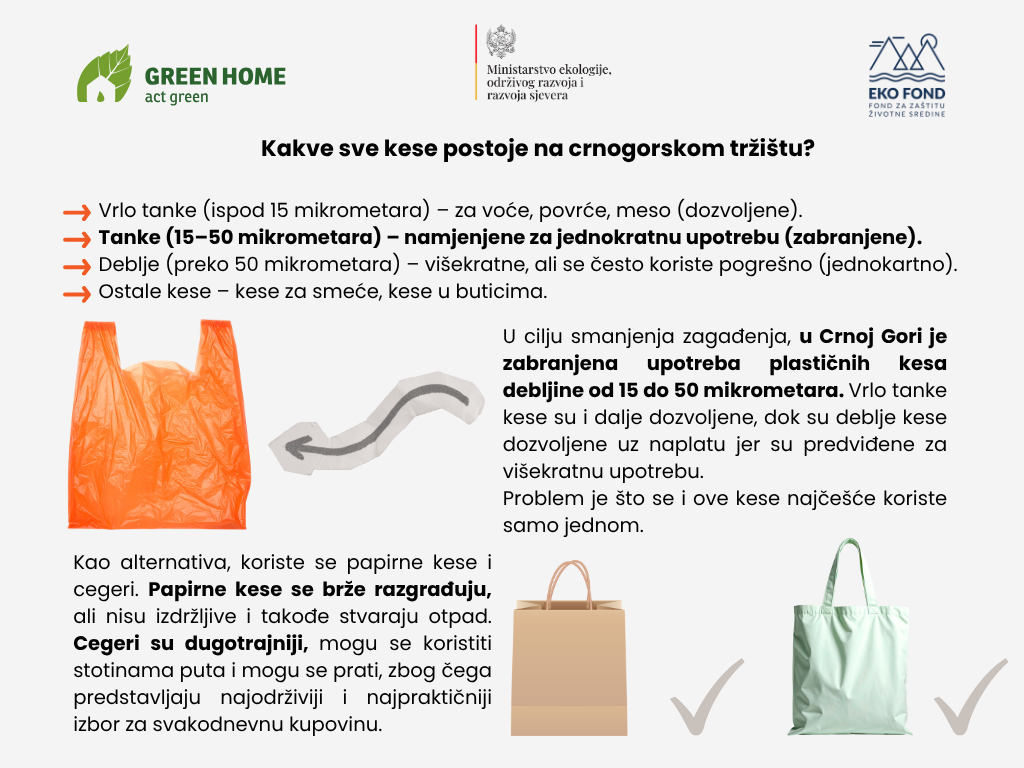
We distinguish:
Very thin bags – usually under 15 micrometers
These are most often used for fruit, vegetables, meat, and baked goods. They are made of polyethylene of different densities. In Montenegro, they are exempt from the ban because they are used for hygienic packaging of loose products.
Thin plastic bags – 15 to 50 micrometers
These are made of polyethylene of different densities. They are lightweight, have limited load capacity, and are intended mainly for single use (carrying light products in supermarkets, pharmacies, and clothing stores). In Montenegro, they are banned from being placed on the market.
Thick plastic bags – 50 micrometers and above
These are stronger, more resistant to tearing and puncturing, and have a higher load capacity. They are intended for multiple use. In Montenegro, they are allowed on the market but are subject to a charge.
Other bags
In addition to the above, garbage bags and special bags for boutiques and pharmacies are also used. They are usually made of thicker polyethylene, available in different sizes and colors, with reinforced handles and higher load capacity, and are intended for multiple use. These bags are not classified as banned in Montenegro, but unfortunately they are most often used as single-use items.
Ban on plastic bags
In order to reduce plastic waste and align with European environmental protection policies, Montenegro has introduced a ban on certain categories of plastic bags. The ban applies to plastic carrier bags with a thickness of 15 to 50 micrometers. Exceptions include very lightweight bags (under 15 micrometers) as well as bags 50 micrometers and thicker, which are considered suitable for reuse, although they are often used only once.
Alternatives
Paper bags are common in stores and bakeries. They break down faster than plastic bags, but they are not ideal for heavy or wet products because they can easily get damaged. Also, their production generates a significant amount of waste, and during decomposition they can release chemicals.
Tote bags are durable and can be used hundreds of times. They are most often made of cotton, jute, or synthetic materials. Their production consumes more resources than plastic bags, but due to their long lifespan they are a more environmentally friendly option. For proper long-term use, tote bags should be washed regularly to keep them hygienic and extend their lifespan.
Conclusion
The most sustainable and practical choice is reusable tote bags. While plastic and paper bags have a limited lifespan and a significant environmental impact, tote bags can be used hundreds of times, are washable, and long-lasting, directly reducing waste and environmental pressure.
The text was created as part of an educational campaign within the project “The Truth About Plastic Bags,” implemented by the NGO Green Home and supported by the Environmental Protection Fund – Eco Fund.
