
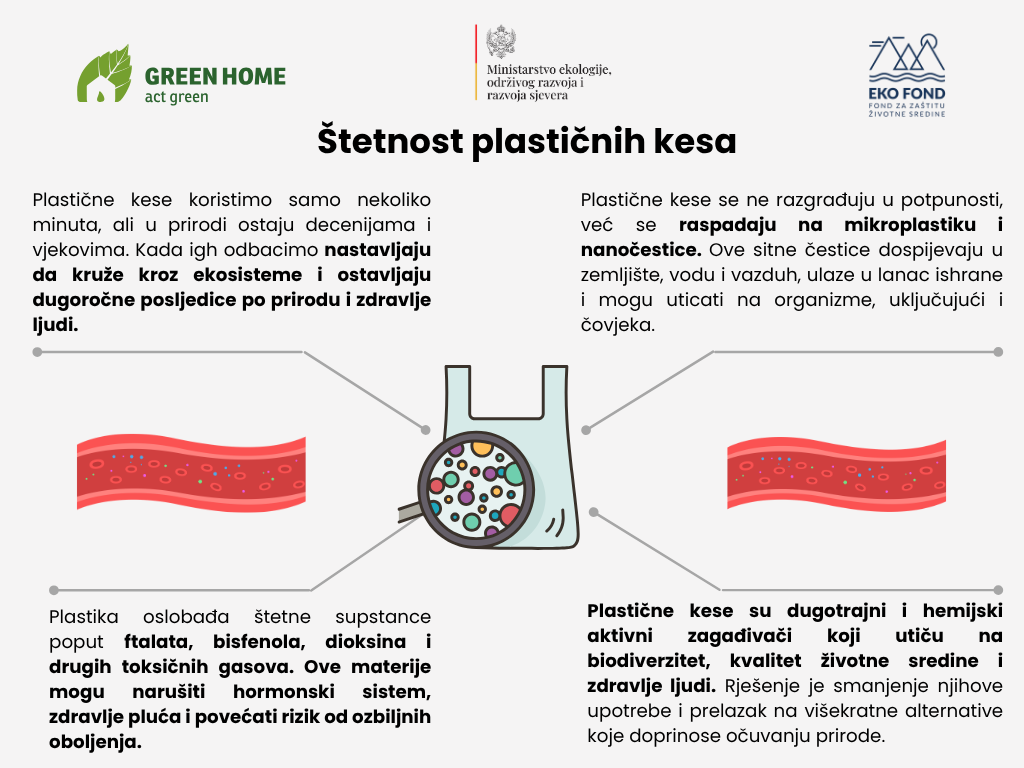
Plastic bags have become a everyday item in modern society due to their convenience and mass consumption. They are easily obtained, used for a few minutes, and then discarded, often without considering their fate in nature. However, the disappearance of a plastic bag from sight does not mean its disappearance from the environment. On the contrary, bags remain present for decades, even centuries, circulating through ecosystems and leaving long-term consequences for biodiversity and human health.
A seemingly harmless plastic bag in nature actually creates serious problems during its breakdown. Plastic gradually fragments into smaller pieces, while external factors such as solar radiation, oxygen, moisture, and mechanical forces trigger chemical reactions that release various substances, including toxic compounds.
Standard plastic bags in Montenegro are made of polyethylene (PE). Their degradation leads to the formation of microplastics and then nanoplastics, which easily spread through the air, accumulate in soil or water, and can enter living organisms. Due to their extremely small size, these particles can pass through cellular barriers, affecting biochemical processes and soil fertility, and reducing the activity of fungi and bacteria in the soil. Once microplastics enter soil or water, they easily enter the food chain, posing a risk to humans as well.
During oxidation, polyethylene can produce chemicals such as phthalates, bisphenols, phosphates, and siloxanes. These substances contaminate soil, sediment, and water. Phthalates and bisphenols act as endocrine disruptors, meaning they can interfere with the hormonal system, metabolism, and reproduction. Some studies also link them to serious diseases.
A particular danger is the burning of plastic bags. Whether in landfills, households, or open spaces, combustion produces toxic gases including dioxins, furans, PFAS, polycyclic aromatic hydrocarbons (PAHs), and volatile organic compounds (VOCs), which irritate the lungs and may be carcinogenic. Burning also releases PM2.5 particles—very fine particles that can penetrate deep into the lungs and are difficult for the body to eliminate.
Plastic bags are not only an aesthetic problem or temporary waste, but chemically active and long-lasting pollutants. Their fragments and chemicals circulate through ecosystems, accumulate in the food chain, and eventually reach humans. It is in this invisible but persistent circulation that their greatest danger lies.
Therefore, the issue of plastic bags is not only a waste management issue, but also a matter of biodiversity protection, environmental quality, and public health. Microplastics and toxic additives are already present in food, water, and air, and this problem must not be ignored. It is important to reduce the use of single-use plastic bags and transition to reusable alternatives.
The text was created as part of an educational campaign within the project “The Truth About Plastic Bags,” implemented by the NGO Green Home and supported by the Environmental Protection Fund – Eco Fund.
